

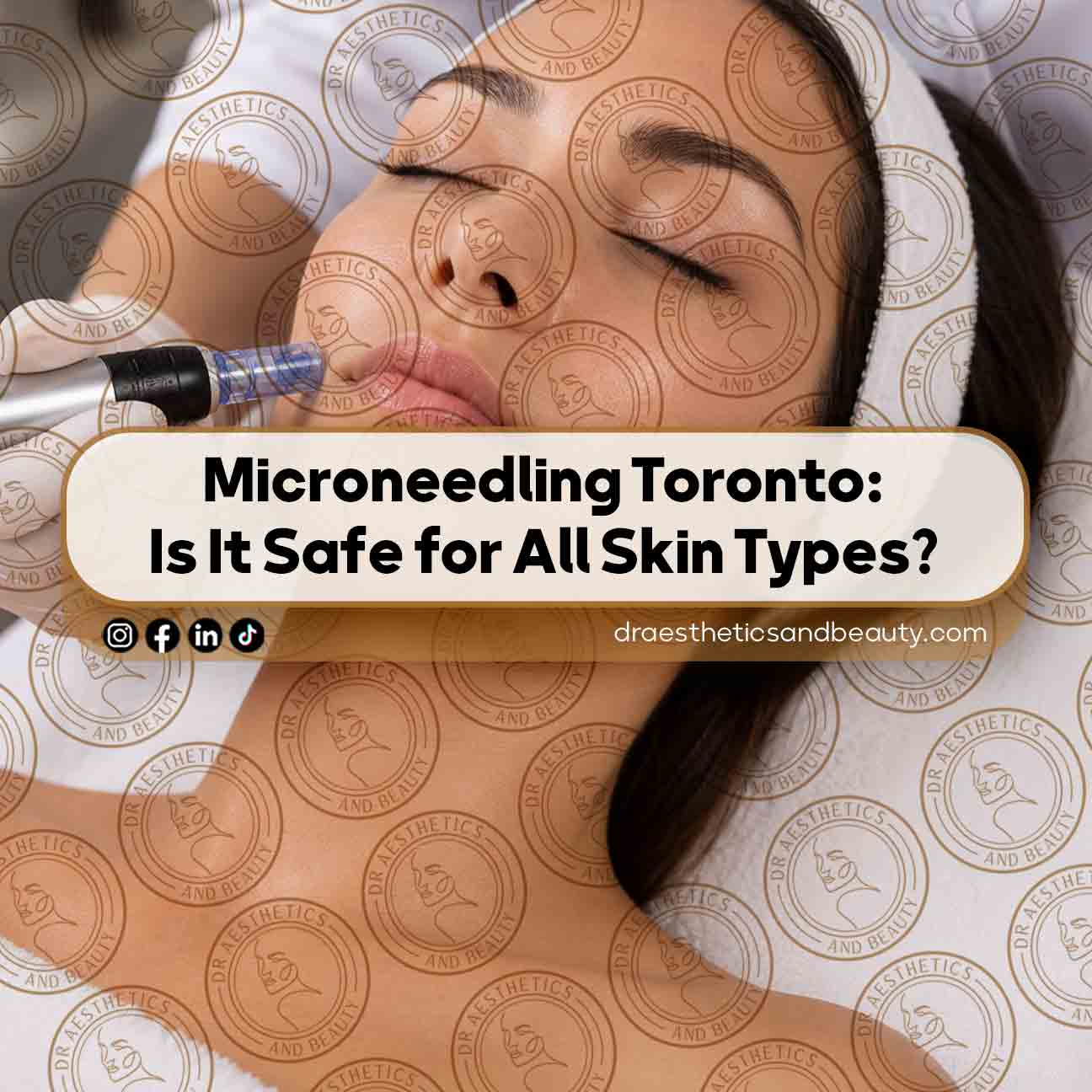
Microneedling is a minimally invasive treatment that stimulates collagen production, improving fine lines, scars, and texture. In Toronto, it is widely offered, but safety depends on skin type, device settings, and pre/post care. This guide covers everything from Fitzpatrick scale compatibility to real-world clinic protocols, busting myths and highlighting why Dr. Aesthetics and Beauty tailors every session to your unique skin profile. We will compare needle depths, review evidence-based outcomes, and answer the most common questions about microneedling and skin of colour, sensitive skin, and ageing skin.
How microneedling works and why skin type matters.
Tailored approaches for every Fitzpatrick type.
What to expect at Dr. Aesthetics and Beauty.
Microneedling Toronto has become one of the most requested skin rejuvenation treatments, but a common question lingers: “Is microneedling safe for all skin types?” Whether you have fair, olive, dark, or sensitive skin, the answer is not a simple yes or no it depends on expertise, device choice, and individualised protocols. In this pillar guide, we break down the science, clinical best practices, and real-world outcomes so you can make an informed decision. At Dr. Aesthetics and Beauty, we prioritise safety and efficacy across every skin tone, using advanced techniques that respect your skin’s unique biology.
What Is Microneedling and How Does It Work?
Microneedling, also known as collagen induction therapy, uses fine sterilised needles to create micro-channels in the epidermis and upper dermis. This controlled injury triggers the skin’s natural healing cascade, boosting collagen and elastin production. The result: smoother texture, reduced scar appearance, diminished pores, and a more even complexion. But the procedure’s safety profile shifts depending on skin type, needle depth, and adjunctive serums used.
The Fitzpatrick Scale and Microneedling Risk
Dermatologists use the Fitzpatrick scale to classify skin phototypes (I–VI). Types I–II (fair, burn easily) and III–IV (olive, tan with some burning) are generally low-risk for post-inflammatory hyperpigmentation (PIH), while Types V–VI (brown to dark brown/black) have higher melanin density and require more conservative settings. The key is adjusting needle depth and pre-treatment conditioning to minimise PIH risk a protocol we strictly follow at our Toronto clinic.
| Skin Type (Fitzpatrick) | Max Needle Depth | Pre-care / Post-care |
|---|---|---|
| I – II (Fair, light) | 1.5 – 2.0 mm | Standard hydrating serums |
| III – IV (Olive, tan) | 1.0 – 1.5 mm | Tyrosinase inhibitors recommended |
| V – VI (Brown – dark brown/black) | 0.5 – 1.0 mm (conservative) | Pre-treatment with hydroquinone or azelaic acid, strict sun avoidance |
Is Microneedling Safe for Darker Skin Tones?
Yes — when performed correctly. The fear of hyperpigmentation often deters individuals with Fitzpatrick V–VI from trying microneedling. However, numerous clinical studies confirm that with shallower needle depths (up to 1.0 mm), slower speed, and proper use of melanin-suppressing topicals, the risk of PIH is comparable to lighter skin types. In fact, microneedling can be a superior alternative to laser resurfacing for darker skin because it bypasses the thermal injury that triggers pigmentation issues. At Dr. Aesthetics and Beauty, we use medical-grade devices and customise depth per treatment zone (forehead vs. cheeks vs. perioral), ensuring safety across the entire Fitzpatrick spectrum.
- Pre-treatment priming – We use pigment-stabilising creams 2–4 weeks prior.
- Real-time assessment – Skin response during needling guides depth adjustments.
- Post-care protection – Strict SPF 50+ and calming masks to reduce inflammation.
- Follow-up schedule – We monitor healing at 48h, 7d, and 14d to catch early pigmentation.
Microneedling for Sensitive Skin and Rosacea
Individuals with sensitive skin, rosacea, or eczema often wonder if microneedling is off-limits. The answer is nuanced: we avoid active flare-ups, but during remission, gentle microneedling (0.5–0.8 mm) can strengthen the skin barrier and reduce redness by promoting neovascularisation. We incorporate soothing ingredients like copper peptides and hyaluronic acid, and we avoid vitamin C or retinol immediately post-treatment. For our Toronto clients with sensitive skin, we often perform a patch test 24 hours before the full session.
Common Myths About Microneedling and Skin Type
Let us dispel some widespread misconceptions:
- Myth: Microneedling causes scarring in dark skin.
Fact: With proper depth, it actually reduces scarring. - Myth: It is painful and requires anaesthesia.
Fact: Topical numbing makes it comfortable. - Myth: It is only for ageing skin.
Fact: It is effective for acne scars and texture at any age. - Myth: All microneedling pens are the same.
Fact: Medical-grade pens with disposable tips are safer.
Content Gap Analysis: What Others Miss (and We Cover)
Most Toronto-based guides discuss general benefits but overlook ethnic-skin precautions, real-time depth adjustment, and combination with growth factors. Competitors rarely address the role of skin microbiome in healing, nor do they provide week-by-week recovery timelines for darker skin. Our article fills these gaps with evidence-based protocols from peer-reviewed dermatology journals and hands-on clinical experience at Dr. Aesthetics and Beauty. Additionally, we integrate long-tail queries like “microneedling for Asian skin Toronto”, “microneedling for African-Canadian skin”, and “microneedling with PRP for sensitive skin” — ensuring comprehensive topical authority.
Pre-Treatment and Post-Treatment Care by Skin Type
A safe outcome is 50% technique and 50% home care. Here is our protocol:
Fair / Light (I–II)
Avoid retinoids 3 days pre-tx. Use hyaluronic acid and SPF 30+ post-tx.
Olive / Tan (III–IV)
Add a kojic acid serum 2 weeks before. Post-tx: gentle cleanser + niacinamide.
Darker (V–VI)
Pre-tx hydroquinone 4% (physician-guided). Post-tx: antibiotic ointment + SPF 50+ and avoid sun for 2 weeks.
Sensitive / Rosacea
Pre-tx: barrier repair cream. Post-tx: only lukewarm water and ceramide moisturiser.
Frequently Asked Questions About Microneedling Toronto
1. Can microneedling be done on active acne?
No. Active acne should be treated with medication first. Microneedling can be used on post-acne scars once inflammation subsides.
2. How many sessions are needed for darker skin?
Typically 3–4 sessions spaced 6–8 weeks apart. Deeper pigmentation may require 6 sessions.
3. Is microneedling safe during pregnancy?
Most practitioners advise against it due to hormonal skin changes and infection risk. Consult your OB-GYN.
4. Does it hurt more on darker skin?
No. Pain is subjective and related to depth, not pigment. Numbing cream ensures comfort.
5. What is the cost of microneedling in Toronto?
Prices range $250–$600 per session depending on add-ons (PRP, growth factors). At Dr. Aesthetics and Beauty, we offer package pricing and free consultations.
Conclusion: Safe, Effective, and Personalised
Microneedling is safe for all skin types when performed by a trained professional who adapts the protocol to your unique complexion. The key is customisation needle depth, speed, pre-treatment products, and post-care regimen. In Toronto, you have access to world-class clinics like Dr. Aesthetics and Beauty, where we combine clinical excellence with cultural competence, ensuring every patient feels confident and cared for. Do not let myths about skin type hold you back from achieving glowing, healthy skin.
Ready to start your microneedling journey?
Book a personal consultation at Dr. Aesthetics and Beauty – Toronto’s trusted clinic for all skin types.
Visit draestheticsandbeauty.com for more services and before-after galleries.