

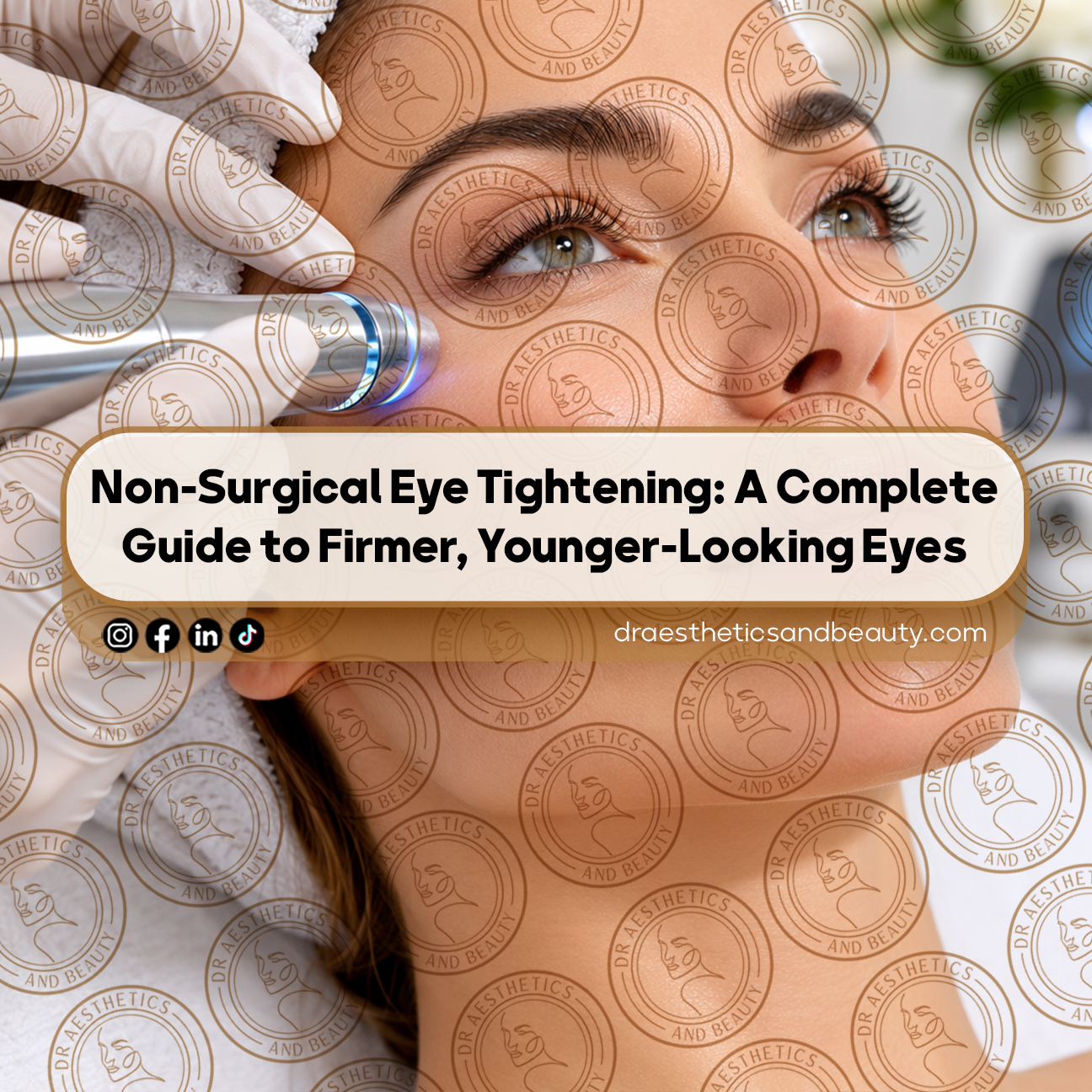
Quick Summary: What You Should Know About Non-Surgical Eye Tightening
- Non-surgical eye tightening includes treatments designed to improve the appearance of loose skin, fine lines, and early signs of ageing around the eyes.
- Radiofrequency and ultrasound technologies may stimulate collagen remodelling and support gradual improvements in skin firmness.
- The best treatment depends on whether the concern involves upper eyelid laxity, under-eye wrinkles, volume loss, pigmentation, or brow position.
- Non-surgical procedures generally involve less recovery than surgery, but results are usually more subtle.
- Some treatments require multiple sessions, while others may produce gradual changes over several weeks or months.
- Eye-area treatments require careful assessment because the skin is delicate and important ocular structures are located nearby.
- A personalized consultation at D&R Aesthetics and Beauty can help determine realistic options and whether a non-surgical approach is suitable.
What if you could address the appearance of ageing around your eyes without immediately considering surgery?
This guide explores three important parts of the decision:
- Understanding the problem: Why the eye area changes with age and how to identify the source of your concerns.
- Understanding your options: How radiofrequency, ultrasound, laser treatments, and other approaches differ.
- Making an informed decision: Who may benefit, what results to expect, how safety is assessed, and what to discuss during a professional consultation.
What Is Non-Surgical Eye Tightening?
Non-surgical eye tightening is a general term for aesthetic procedures intended to improve the appearance of skin laxity, fine wrinkles, and age-related changes around the eyes without surgically removing eyelid tissue.
Unlike traditional blepharoplasty, which involves surgical alteration of eyelid skin and sometimes underlying fat or muscle, non-surgical procedures generally work through controlled energy delivery, skin resurfacing, or carefully selected injectable treatments.
Some technologies target the dermis, the skin layer responsible for much of its structural support. Others deliver energy to deeper tissue structures. The objective may be to encourage collagen remodelling, improve skin texture, or create a modest tightening effect.
It is important to understand that these treatments do not all accomplish the same thing. A treatment that improves fine wrinkles may have limited effects on substantial excess eyelid skin. Similarly, a procedure designed to improve skin firmness cannot necessarily correct under-eye hollowness or prominent fat pockets.
What Areas Can Be Addressed?
Depending on the specific technology, treatment indication, device instructions, and provider’s qualifications, non-surgical eye rejuvenation may focus on:
- Upper eyelid skin: Mild skin laxity that creates a less defined upper eyelid appearance.
- Lower eyelid skin: Fine wrinkles, crepey texture, and selected cases of mild skin looseness.
- Crow’s feet: Fine lines around the outer corners of the eyes.
- Under-eye area: Selected texture and skin-quality concerns.
- Periorbital region: The surrounding area extending from the eyelids to the outer eye corners and adjacent skin.
- Brow area: Selected concerns involving the position and appearance of the brow, although brow lifting and eyelid tightening are not interchangeable treatments.
Not every device is approved, cleared, or intended for every anatomical location. In particular, treatment directly on the eyelids requires device-specific protocols and appropriate ocular protection. A provider must establish whether a proposed treatment is suitable for the exact area being considered.
Why Does the Skin Around the Eyes Become Loose?
The eye area has distinctive anatomical characteristics that make it particularly susceptible to visible ageing. The skin is relatively thin, the underlying support structures change over time, and repeated facial movements contribute to the development of expression lines.
Several biological and environmental factors can contribute to the changes patients notice.
1. Collagen and Elastin Reduction
Collagen provides structural support to the skin, while elastin contributes to its ability to stretch and return to its original position. As natural ageing progresses, the production and organization of these proteins change.
The skin may gradually become thinner, less resilient, and less able to maintain its previous firmness. Around the eyes, these changes can make fine lines and loose skin more noticeable.
2. Repeated Facial Expressions
Smiling, squinting, blinking, and other everyday facial movements activate muscles surrounding the eyes. Over many years, repeated movement can contribute to the formation of expression lines.
Initially, these lines may appear primarily when the muscles contract. Over time, some can become visible even when the face is at rest.
3. Sun Exposure and Photoageing
Ultraviolet exposure can contribute to collagen breakdown, uneven pigmentation, and changes in skin texture. The delicate eye area is particularly vulnerable because people sometimes apply insufficient sun protection around the orbital region.
Consistent broad-spectrum sun protection, appropriate sunglasses, and protective skincare habits can help reduce additional environmental damage.
4. Changes in Fat Distribution and Facial Support
Ageing does not affect the skin alone. The deeper tissues surrounding the eyes also change. Fat compartments may shift, supporting structures may weaken, and the relationship between the eyelids, brow, and cheek can change.
These structural changes may contribute to hollowing, under-eye shadows, or prominent lower eyelid bags.
Importantly, these concerns are not necessarily caused by loose skin. A skin-tightening procedure may therefore have limited benefit when the primary issue is volume loss or fat protrusion.
5. Genetics and Individual Anatomy
Some people develop visible eyelid laxity or under-eye changes earlier than others. Family characteristics, natural skin thickness, bone structure, and individual facial anatomy can influence how the eye area ages.
This is why treatment planning should be based on an individual assessment rather than age alone.
Signs You May Be Considering Non-Surgical Eye Tightening
People explore non-surgical eye rejuvenation for different reasons. Some notice subtle changes in skin texture, while others are concerned about the appearance of their upper or lower eyelids.
Common concerns include:
- Fine lines beneath the eyes.
- Crepey or thin-looking lower eyelid skin.
- Mild looseness around the outer eye corners.
- Early upper eyelid skin laxity.
- Reduced skin firmness around the orbital area.
- A tired-looking appearance associated with skin texture changes.
- Fine wrinkles that remain visible when the face is relaxed.
However, some symptoms that appear cosmetic may have another explanation. Persistent eyelid swelling, sudden changes in eyelid position, dry eyes, irritation, or visual difficulties should not automatically be treated as aesthetic concerns.
When symptoms involve vision, eye discomfort, or changes in eyelid function, an appropriate medical or ophthalmological assessment should take priority.
How Does Non-Surgical Eye Tightening Work?
Different treatments use different mechanisms. Understanding these differences helps patients avoid assuming that all non-surgical procedures produce the same result.
Some treatments deliver controlled thermal energy to stimulate collagen remodelling. Others create microscopic treatment zones that activate the skin’s healing response. Certain injectable treatments work by relaxing targeted muscles or improving selected volume-related concerns.
Collagen Remodelling
Collagen remodelling is one of the main concepts behind energy-based skin-tightening procedures.
When an appropriate device delivers controlled energy to its intended tissue target, the resulting thermal response may initiate a healing and remodelling process. Over time, changes in collagen organization and production may contribute to improved skin firmness.
The process is gradual. A patient should not expect the full result immediately after a treatment session.
Controlled Radiofrequency Energy
Radiofrequency technology uses electrical energy to generate heat within targeted tissue. Depending on the device, treatment settings, and applicator, the energy can be delivered through the skin surface or through microneedles.
The intended aesthetic effect may include collagen contraction and subsequent remodelling. These effects can help improve the appearance of selected wrinkles and mild skin laxity.
However, radiofrequency is not a single standardized treatment. Different systems have different energy-delivery mechanisms, treatment depths, safety requirements, and anatomical indications.
Ultrasound-Based Skin Tightening
Ultrasound skin-tightening technologies use focused acoustic energy to create controlled thermal effects at selected tissue depths.
Depending on the device and treatment indication, this may stimulate a tissue response associated with collagen remodelling and gradual improvements in skin firmness.
Ultrasound-based treatments are not automatically suitable for the eyelids. The exact treatment area and device instructions must be reviewed before considering any application near the eyes.
Skin Resurfacing and Texture Improvement
Laser and other resurfacing procedures can address selected surface-level concerns, including fine wrinkles, uneven texture, and photodamage.
Different laser systems work at different depths and have different recovery requirements. Some are ablative, while others are non-ablative or fractional.
The choice depends on the patient’s skin characteristics, treatment goals, tolerance for downtime, and risk of pigmentation changes.
Types of Non-Surgical Eye Tightening Treatments
There is no single treatment that addresses every type of eye-area ageing. A useful consultation begins by identifying the primary concern and matching it with a suitable treatment approach.
1. Radiofrequency Skin Tightening
Radiofrequency skin tightening is a non-surgical approach that uses controlled electrical energy to heat targeted tissue.
Depending on the technology, this energy may be delivered through an external applicator or through a microneedling handpiece. The objective is to stimulate a tissue response that may improve skin firmness and texture over time.
Potential benefits for appropriately selected treatment areas include:
- Improvement in the appearance of mild skin laxity.
- Gradual improvement in selected fine lines.
- Support for collagen remodelling.
- Improvement in skin texture.
- Non-surgical treatment without traditional eyelid incisions.
Important distinction: Surface-applied radiofrequency and RF microneedling are not the same procedure. RF microneedling uses needles to deliver energy into tissue and carries a different risk profile. It should not be assumed that a device suitable for the face is suitable for the eyelids.
2. XERF Radiofrequency Technology
XERF is a non-invasive radiofrequency technology featured in the treatment offerings of D&R Aesthetics and Beauty.
The system uses multifrequency radiofrequency energy delivered through a handpiece placed on the skin. Its treatment approach is designed to support collagen remodelling and improve the appearance of skin laxity.
According to the clinic’s published XERF treatment information, the technology includes adjustable treatment settings, multifrequency energy delivery, and integrated surface cooling.
Potential advantages of this approach include:
- Non-invasive treatment without microneedles.
- Adjustable energy delivery based on the treatment assessment.
- A treatment approach focused on collagen remodelling.
- Potential improvement in the appearance of selected skin-laxity concerns.
- Gradual changes rather than an immediate surgical-style result.
For patients researching non-surgical eye tightening, it is particularly important to clarify the exact anatomical area that can be treated with the device. The presence of a non-surgical blepharoplasty treatment option in a clinic’s service collection does not mean every eyelid concern is appropriate for every XERF protocol.
Direct eyelid treatment must only be considered where the device’s instructions, applicable regulatory requirements, and the treating provider’s qualifications specifically support it.
3. High-Intensity Focused Ultrasound (HIFU)
High-intensity focused ultrasound uses focused sound-wave energy to create controlled thermal effects within selected tissue layers.
Some HIFU technologies are used for facial skin tightening and lifting. The objective is to stimulate a biological response that may improve the appearance of skin firmness over time.
Potential treatment goals may include:
- Improving the appearance of selected facial laxity.
- Supporting gradual collagen remodelling.
- Improving the appearance of selected lower-face contours.
- Providing a non-surgical alternative for mild skin-firmness concerns.
D&R Aesthetics and Beauty offers 3D HIFU as part of its ultrasound treatment category. However, a general facial HIFU treatment should not be confused with a specialized eyelid procedure.
Patients should ask which exact device and applicator are being considered, whether the intended eye-area treatment is within the manufacturer’s instructions, and what ocular protection is required.
4. Morpheus8 Radiofrequency Microneedling
Morpheus8 combines microneedling with radiofrequency energy. Fine needles enter the skin and deliver energy at selected depths, creating controlled treatment zones that stimulate a healing response.
The treatment is used for selected concerns involving skin texture, wrinkles, and laxity in approved treatment areas.
Potential benefits may include:
- Improvement in selected wrinkles.
- Support for collagen remodelling.
- Improvement in skin texture.
- Addressing selected facial skin-laxity concerns.
Although Morpheus8 is available at D&R Aesthetics and Beauty, it should not automatically be considered an eyelid-tightening treatment. The depth of needle penetration, proximity to the eye, and device-specific indications require careful professional evaluation.
RF microneedling also deserves particular caution. The US FDA issued a safety communication in October 2025 describing reports of serious complications associated with certain uses of RF microneedling, including burns, scarring, unwanted fat loss, disfigurement, and nerve injury.
Patients should discuss the exact device, operator training, treatment depth, and potential complications rather than relying on general claims that RF microneedling is suitable for everyone.
5. Laser Skin Resurfacing
Laser resurfacing uses focused light energy to target selected skin structures. Depending on the laser, the procedure may remove or remodel portions of the skin’s surface or stimulate changes in deeper tissue.
Laser treatments may be considered for:
- Fine wrinkles.
- Photodamage.
- Uneven skin texture.
- Selected pigmentation concerns.
- Some signs of skin ageing.
Laser resurfacing does not necessarily correct excess eyelid skin. The procedure also requires careful consideration of skin tone, pigmentation history, recovery time, and eye protection.
6. Neuromodulators for Expression Lines
Botulinum toxin type A products may be used to reduce the appearance of selected dynamic wrinkles by temporarily relaxing targeted muscles.
They are commonly considered for crow’s feet when facial movement is the main cause of the lines.
However, neuromodulators do not directly tighten loose eyelid skin or remove excess tissue. Incorrect placement or unsuitable treatment can affect eyelid position, facial expression, or eye function.
They should therefore be viewed as a treatment for selected expression lines rather than a replacement for skin-tightening procedures.
7. Dermal Fillers for Selected Under-Eye Concerns
Hyaluronic acid fillers may be considered for carefully selected patients whose primary concern is volume loss or tear-trough hollowing.
They do not tighten excess eyelid skin. Instead, they are intended to improve contour by restoring selected areas of lost volume.
Under-eye filler treatment requires advanced anatomical knowledge because the area contains important blood vessels and is associated with rare but serious complications, including vascular occlusion and visual injury.
It is not appropriate for every patient, particularly those with significant puffiness, prominent fat pads, or certain types of under-eye swelling.
Comparison of Non-Surgical Eye Tightening Options
The following table explains the general differences between common approaches. It is not a treatment recommendation, and actual indications depend on the individual device and clinical assessment.
| Treatment | Main Target | How It Works | Important Consideration |
|---|---|---|---|
| XERF RF | Selected skin laxity | Surface-applied multifrequency radiofrequency | Confirm suitability for the exact anatomical area. |
| HIFU | Selected deeper tissue and facial laxity | Focused ultrasound energy | Not every device or applicator is suitable near the eyelids. |
| Morpheus8 | Texture, wrinkles, selected laxity | Microneedling combined with radiofrequency | Invasive compared with surface-applied RF; device-specific safety assessment is essential. |
| Laser resurfacing | Fine lines, texture, photodamage | Controlled light-based skin treatment | Recovery and pigmentation risks vary by laser type. |
| Botulinum toxin | Dynamic expression lines | Temporary muscle relaxation | Does not remove loose skin. |
| Dermal fillers | Selected volume deficiencies | Restoration of soft-tissue volume | Does not tighten excess skin and carries specific vascular risks. |
| Blepharoplasty | Significant excess eyelid skin or fat | Surgical removal or repositioning of tissue | Involves surgery, recovery, and surgical risks. |
Non-Surgical Eye Tightening vs. Surgical Blepharoplasty
One of the most important decisions is understanding when a non-surgical approach may be reasonable and when surgery is more appropriate.
Non-surgical treatments generally aim for gradual, modest improvements. Blepharoplasty is a surgical procedure that can address structural problems such as significant excess eyelid skin and selected fat-related changes.
When a Non-Surgical Approach May Be Considered
- Mild skin laxity.
- Early changes in skin firmness.
- Fine lines or selected texture concerns.
- A preference to avoid surgery.
- Realistic expectations about gradual and potentially subtle improvement.
When Surgery May Be More Appropriate
- Significant excess upper eyelid skin.
- Pronounced lower eyelid fat protrusion.
- Advanced eyelid laxity.
- Structural changes that cannot reasonably be corrected with energy-based treatments.
- Functional concerns, such as skin obstructing the visual field.
Patients with suspected functional eyelid problems should be assessed by an appropriate medical professional. Cosmetic skin tightening should not delay an assessment of impaired vision or eyelid function.
Who Is a Good Candidate for Non-Surgical Eye Tightening?
There is no universal age or skin type that automatically makes someone a suitable candidate. The decision depends on the cause and severity of the concern, general health, skin characteristics, and the specific treatment being considered.
Potential candidates may include individuals who:
- Have mild or early skin laxity.
- Want to improve selected fine wrinkles.
- Prefer to explore non-surgical options before considering surgery.
- Understand that results may be subtle.
- Can follow pre-treatment and post-treatment instructions.
- Have realistic expectations about what a particular device can achieve.
Who May Not Be an Appropriate Candidate?
A provider may recommend postponing or avoiding treatment in certain circumstances, including:
- Active infection or inflammation in the treatment area.
- Unexplained eyelid swelling or an undiagnosed eye condition.
- Recent cosmetic procedures that may affect treatment timing.
- Medical implants or devices that conflict with the energy technology being considered.
- Pregnancy or breastfeeding when the device or treatment protocol advises against elective treatment.
- Medical conditions or medications that may increase treatment risks.
- Significant excess skin or structural changes requiring a different intervention.
This list is not exhaustive. Suitability must be assessed individually and according to the instructions for the exact device and procedure.
What Happens During a Non-Surgical Eye Tightening Consultation?
A consultation is more than a discussion about which treatment is popular. It should identify the anatomical source of the concern and establish whether the proposed procedure is appropriate.
Step 1: Discuss Your Concerns
The provider should ask what changes you have noticed, how long they have been present, and which areas concern you most.
For example, someone concerned about crepey lower eyelid skin may need a different assessment from someone whose main concern is upper eyelid heaviness or crow’s feet.
Step 2: Review Medical and Treatment History
Relevant information may include:
- Previous cosmetic treatments.
- History of eyelid or eye surgery.
- Current medications and supplements.
- Known allergies or skin sensitivities.
- History of eye disease or dry eye symptoms.
- Medical implants or electronic devices.
- Previous reactions to energy-based procedures.
Step 3: Assess Skin and Facial Anatomy
The provider should assess the skin’s condition, degree of laxity, wrinkle patterns, brow position, and the relationship between the upper and lower eyelids.
Where appropriate, a medical or ophthalmological evaluation may be necessary before proceeding.
Step 4: Discuss Suitable Treatment Options
Once the main concern has been identified, the provider can explain which treatments may be appropriate and which should be avoided.
A good treatment recommendation should include:
- The intended treatment area.
- The specific device and technology.
- The expected degree of improvement.
- Potential risks and side effects.
- Expected recovery requirements.
- Alternative treatment approaches.
- Estimated treatment schedule and costs.
Step 5: Establish a Personalized Plan
The final plan should be based on clinical suitability rather than a predetermined package.
At D&R Aesthetics and Beauty, the clinic’s published consultation process emphasizes reviewing individual concerns, medical history, skin condition, treatment suitability, and realistic expectations before developing a treatment plan.
What to Expect During the Treatment
The experience depends on the technology being used. A surface-applied radiofrequency procedure is different from microneedling, laser resurfacing, or ultrasound treatment.
For a suitable non-invasive radiofrequency procedure, the general process may include:
- Preparation: The treatment area is examined and prepared according to the device protocol.
- Protection: Appropriate eye protection is used whenever required by the technology and treatment location.
- Energy delivery: The provider applies the device using the selected settings and treatment technique.
- Comfort monitoring: The patient’s response is monitored throughout the session.
- Aftercare: Instructions are provided according to the specific treatment performed.
Patients may experience warmth, pressure, mild discomfort, or temporary skin sensitivity. The exact sensation depends on the device and individual tolerance.
Never assume that a procedure is safe around the eyes simply because it is non-invasive. The provider must follow the manufacturer’s instructions and use appropriate protective measures.
Results: How Long Does Non-Surgical Eye Tightening Take?
Results depend on the treatment technology, the patient’s skin characteristics, the severity of laxity, and the body’s response.
Some energy-based treatments may produce an initial sensation or appearance of firmness. However, the more gradual component of improvement is associated with tissue remodelling, which develops over time.
Immediately After Treatment
Some patients notice temporary changes in skin appearance or firmness. Mild redness, warmth, or swelling may also occur.
These early changes should not be confused with the final outcome.
Over the Following Weeks
The skin may gradually respond to the treatment through its natural repair and remodelling processes. The timing varies considerably between technologies and individuals.
Over the Following Months
For treatments that rely on collagen remodelling, improvement may continue over several months. A follow-up assessment can help determine whether the intended changes have developed.
There is no responsible way to guarantee a particular degree of tightening or a specific duration of results for every patient.
How Long Do the Results Last?
The longevity of non-surgical eye tightening results varies according to the treatment type and individual ageing process.
Several factors may influence how long improvements remain visible:
- Age and natural collagen changes.
- Baseline skin laxity.
- Sun exposure and environmental damage.
- Smoking and lifestyle factors.
- Skin-care habits.
- The technology and treatment protocol used.
- Whether maintenance treatments are appropriate.
Non-surgical treatments do not stop the natural ageing process. Some patients may benefit from maintenance, while others may not require additional treatment for an extended period.
The appropriate schedule should be based on follow-up assessments rather than automatically repeating a procedure at fixed intervals.
Recovery and Aftercare
One reason patients consider non-surgical procedures is the possibility of less downtime compared with surgery. However, recovery requirements vary according to the device and treatment intensity.
Common Temporary Reactions
Depending on the procedure, temporary reactions may include:
- Mild redness.
- Temporary swelling.
- Warmth or tenderness.
- Temporary sensitivity.
- Minor bruising with certain procedures.
- Dryness or flaking after selected resurfacing treatments.
Recommended Aftercare Principles
- Follow the exact instructions provided by your treatment professional.
- Avoid excessive sun exposure during recovery.
- Use appropriate broad-spectrum sun protection.
- Keep the skin hydrated with recommended products.
- Avoid aggressive exfoliation until the provider confirms it is appropriate.
- Do not rub or apply unnecessary pressure to the treated area.
- Attend recommended follow-up appointments.
Seek prompt medical assessment if you experience severe or worsening pain, blistering, significant swelling, new visual symptoms, or any unexpected eye-related complication.
Risks and Safety Considerations
Non-surgical does not mean risk-free. Every aesthetic procedure has potential complications, and treatments performed near the eyes require particular attention because of the anatomy of the eyelids and orbit.
Possible complications vary by treatment and may include:
- Redness and swelling.
- Temporary discomfort or tenderness.
- Burns or thermal injury.
- Changes in pigmentation.
- Scarring in some procedures.
- Unwanted tissue or fat changes.
- Infection with procedures that disrupt the skin barrier.
- Eye injury if appropriate protection is not used.
Why Eye Protection Matters
The eyes contain delicate structures that can be affected by inappropriate energy exposure. Certain light-based and energy-based devices require specific protective eyewear or other ocular protection measures.
Protection must be appropriate for the device and wavelength or energy type. Ordinary sunglasses are not a substitute for professional treatment protection.
Why Device Selection Matters
Different devices have different indications and safety requirements. A treatment that is suitable for the cheeks or jawline may not be appropriate for the eyelids.
Before treatment, ask the provider:
- Is this device specifically intended for the proposed treatment area?
- What are the manufacturer’s restrictions?
- What training is required to operate it?
- What eye-protection protocol is used?
- What complications have been reported?
- What alternatives are available?
These questions help patients make informed decisions and distinguish evidence-based treatment planning from exaggerated marketing claims.
Non-Surgical Eye Tightening at D&R Aesthetics and Beauty
Choosing a clinic is an important part of the treatment decision. Patients should look beyond the name of a technology and understand how the clinic evaluates suitability, explains risks, and plans treatment.
D&R Aesthetics and Beauty is a cosmetic clinic serving the Vaughan and surrounding communities. Its published service offering includes injectable treatments, laser treatments, radiofrequency and ultrasound technologies, and medical skincare.
The clinic’s treatment collection includes XERF, Morpheus8, and 3D HIFU. These technologies have different mechanisms and indications, making individualized assessment essential.
XERF: A Non-Invasive Radiofrequency Option
XERF is presented by the clinic as a non-invasive radiofrequency approach designed to support collagen remodelling and improve the appearance of selected skin-laxity concerns.
Its surface-applied handpiece does not use microneedles. Adjustable settings and integrated cooling form part of its treatment approach.
Patients interested in eye-area rejuvenation should ask whether their particular concern and intended anatomical location are suitable for the available XERF protocol.
Morpheus8: Microneedling and Radiofrequency
Morpheus8 combines microneedling with radiofrequency energy and is offered by the clinic for selected skin concerns, including wrinkles and skin texture changes.
It is a different technology from surface-applied XERF. Its use around delicate eyelid structures requires careful consideration of device-specific indications and risks.
3D HIFU: Ultrasound-Based Skin Treatment
The clinic also offers 3D HIFU as an ultrasound-based treatment for selected facial and neck skin-tightening concerns.
HIFU treatment should be selected according to the intended tissue depth and device instructions. A general face-lifting protocol should not be assumed to be suitable for direct eyelid treatment.
A Personalized Approach to Aesthetic Treatment
The clinic’s published consultation process emphasizes reviewing the patient’s concerns, medical history, skin condition, treatment suitability, and realistic expectations.
This type of assessment is especially important when patients are comparing multiple treatments or considering procedures around the eyes.
The objective should be to identify the most appropriate approach, not simply to recommend the newest or most heavily advertised technology.
How Much Does Non-Surgical Eye Tightening Cost?
The cost of non-surgical eye tightening varies according to the technology, treatment area, provider, number of sessions, and complexity of the treatment plan.
Some procedures are performed in a single session, while others may involve a series of appointments. Treatments that require specialized applicators or additional clinical assessment may also have different pricing structures.
Factors That Influence Treatment Cost
- Technology: Different radiofrequency, ultrasound, and laser systems have different operational requirements.
- Treatment area: Upper eyelid, lower eyelid, and surrounding facial areas may require different approaches.
- Number of sessions: Some treatment plans involve multiple appointments.
- Provider expertise: Appropriate training and experience are important considerations.
- Follow-up care: Assessment and aftercare may form part of the overall treatment plan.
- Individual suitability: Additional evaluation or alternative treatment recommendations may affect the final plan.
Patients should request a clear explanation of the recommended treatment, what is included, and whether additional sessions or maintenance may be considered.
At D&R Aesthetics and Beauty, treatment pricing is discussed as part of the personalized consultation process.
How to Choose the Right Eye Tightening Treatment
Comparing treatments can become confusing because aesthetic technologies are often advertised using similar terms, including lifting, tightening, rejuvenation, and collagen stimulation.
A practical approach is to begin with the actual concern rather than the name of the treatment.
| Main Concern | Treatment Categories to Discuss | What to Clarify |
|---|---|---|
| Fine lines | Resurfacing, selected energy-based procedures, neuromodulators for dynamic lines | Are the lines caused by movement or skin-quality changes? |
| Mild skin laxity | Appropriately indicated radiofrequency or ultrasound treatments | Is the device suitable for the exact treatment area? |
| Under-eye hollowness | Selected volume-restoration approaches or other structural treatments | Is volume loss the primary issue? |
| Under-eye bags | Medical assessment and, in selected cases, surgical consultation | Are fat protrusion or fluid retention involved? |
| Significant upper eyelid skin excess | Specialist assessment and possible blepharoplasty | Is surgery more appropriate than non-surgical tightening? |
| Dark circles | Cause-specific skincare, pigmentation or vascular assessment, selected procedures | Are pigmentation, vascular visibility, or shadows responsible? |
Common Mistakes to Avoid Before Eye Tightening
Patients can make better decisions when they understand what non-surgical procedures can and cannot accomplish.
Mistake 1: Assuming Every Treatment Can Lift the Eyelids
Different treatments target different structures. Some improve fine lines, while others address skin texture or selected laxity. None should be assumed to correct every eyelid concern.
Mistake 2: Choosing a Treatment Based Only on Price
Price is only one part of the decision. Device suitability, provider qualifications, safety procedures, and realistic treatment goals are equally important.
Mistake 3: Expecting Surgical Results Without Surgery
Non-surgical procedures generally offer more modest improvements than surgical eyelid correction. Significant excess skin may require a different approach.
Mistake 4: Ignoring Eye-Protection Requirements
Procedures using light or energy near the eyes require appropriate safety protocols. Patients should never proceed without understanding how the eyes will be protected.
Mistake 5: Combining Treatments Without a Plan
Multiple procedures do not automatically produce better results. Combining treatments without considering their mechanisms, timing, and potential interactions can increase risk.
Mistake 6: Following Inappropriate Home Devices
Professional treatments and home-use devices have different energy levels, instructions, and restrictions. A device intended for the cheeks or forehead should never be used on the eyelids unless its instructions specifically permit that use.
How to Maintain Healthier-Looking Skin Around the Eyes
Professional treatments are only one part of maintaining the appearance of the eye area. Consistent daily habits can help protect skin quality and reduce additional environmental damage.
Use Daily Sun Protection
UV exposure contributes to premature skin ageing. Use an appropriate broad-spectrum sunscreen and sunglasses that provide UV protection.
Choose Gentle Skincare
The eye area can be easily irritated by aggressive products. Select products designed for the intended area and introduce active ingredients gradually.
Maintain Skin Hydration
Appropriate moisturizers can support the skin barrier and improve the temporary appearance of dryness and fine surface lines.
Avoid Smoking
Smoking is associated with accelerated skin ageing and can negatively affect the skin’s appearance and repair processes.
Maintain Realistic Expectations
Healthy skincare habits can support skin quality, but they cannot remove significant excess eyelid skin or correct all structural changes associated with ageing.
Frequently Asked Questions About Non-Surgical Eye Tightening
1. What is the best non-surgical eye tightening treatment?
There is no single best treatment for everyone. Radiofrequency, ultrasound, laser resurfacing, and selected injectable treatments address different concerns. The appropriate option depends on whether the main issue is loose skin, fine wrinkles, volume loss, or muscle movement. A professional assessment is necessary before selecting a treatment.
2. Can you tighten eyelid skin without surgery?
Selected non-surgical treatments may improve the appearance of mild eyelid-area skin laxity. However, results are generally more limited than surgical blepharoplasty. Significant excess skin may require surgical evaluation rather than energy-based treatment.
3. Does radiofrequency tighten the skin around the eyes?
Certain radiofrequency technologies can support collagen remodelling and may improve selected skin-firmness concerns. However, not every RF device is designed or indicated for direct eyelid treatment. Device-specific instructions and professional assessment are essential.
4. Is XERF suitable for non-surgical eye tightening?
XERF is a non-invasive radiofrequency technology designed to support collagen remodelling and improve selected skin-laxity concerns. Whether it is suitable for a particular eye-area concern depends on the exact anatomical location, device instructions, treatment protocol, and provider assessment. Patients should confirm these details during consultation.
5. How long does non-surgical eye tightening last?
Results vary according to the technology, treatment area, skin condition, and natural ageing process. Some improvements may remain visible for an extended period, but no treatment permanently stops skin ageing. Maintenance requirements should be discussed individually.
6. How many sessions are needed?
The number of sessions depends on the device and treatment goal. Some procedures may be performed as a single session, while others involve a series of treatments. The recommended schedule should be established after assessing the skin and reviewing the device protocol.
7. Is non-surgical eye tightening painful?
The level of discomfort varies by procedure and individual sensitivity. Some treatments create a warm sensation, while microneedling or resurfacing procedures may involve additional discomfort. The provider should explain pain-management options before treatment.
8. Is there downtime after treatment?
Downtime depends on the technology and treatment intensity. Some non-invasive procedures involve minimal recovery, while microneedling and laser resurfacing may cause redness, swelling, sensitivity, or peeling. Follow the aftercare instructions provided by the clinic.
9. Can non-surgical eye tightening remove under-eye bags?
Not necessarily. Under-eye bags may result from fat protrusion, fluid retention, or structural changes. Skin tightening may improve selected surface concerns but does not reliably remove prominent fat pads. The cause should be identified before treatment.
10. Can non-surgical treatments improve dark circles?
Some treatments may help selected pigmentation or skin-quality concerns, but dark circles have multiple causes. Pigmentation, visible blood vessels, thin skin, and anatomical shadows may require different approaches. Correct diagnosis is important.
11. What is the difference between eye tightening and a non-surgical eye lift?
These terms are sometimes used interchangeably in aesthetic marketing. Eye tightening usually refers to improving skin firmness, while an eye lift may describe a broader improvement in the appearance of the eyelids or brow. Neither term guarantees the removal of excess tissue or correction of structural eyelid problems.
12. Is non-surgical eye tightening safe?
It can be appropriate for selected patients when the correct device and treatment protocol are used by a suitably trained provider. Potential risks include swelling, burns, pigmentation changes, and other device-specific complications. Treatments around the eyes require particular attention to ocular protection.
13. Can I combine radiofrequency with Botox?
Some patients may be candidates for a treatment plan involving more than one modality. However, the procedures should not be combined automatically. Timing, treatment depth, injection location, and potential interactions should be reviewed by the treating professionals.
14. Can younger patients benefit from eye tightening?
Age alone does not determine suitability. Some younger adults may have early skin laxity or texture concerns, while others may not benefit from treatment. An assessment should establish whether a genuine treatment indication exists.
15. Is non-surgical eye tightening better than blepharoplasty?
Neither option is universally better. Non-surgical treatments may suit mild concerns and patients seeking modest improvements without surgery. Blepharoplasty is generally more appropriate for significant excess eyelid skin or selected structural concerns. The choice depends on anatomy and treatment goals.
16. Can I return to normal activities after treatment?
Many non-invasive procedures involve limited downtime, but recovery varies. Your provider should explain when you can resume exercise, skincare products, makeup, and sun exposure based on the exact procedure performed.
17. Does non-surgical eye tightening work for all skin types?
Suitability varies by technology, wavelength, energy settings, and individual skin characteristics. Some procedures carry a higher risk of pigmentation changes in certain skin tones. A provider should assess skin type and previous reactions before recommending treatment.
18. What should I avoid before treatment?
Avoid making independent changes to prescribed medication. Inform the provider about recent cosmetic treatments, active skin irritation, medications, supplements, medical implants, and eye conditions. Follow the preparation instructions specific to the procedure.
19. Can non-surgical treatments correct drooping eyelids?
Treatment depends on the cause of the drooping. Loose skin, brow descent, and true eyelid ptosis are different conditions. Energy-based tightening cannot reliably correct every type of eyelid drooping. True ptosis requires appropriate medical assessment.
20. Where can I explore non-surgical eye tightening options near Vaughan?
D&R Aesthetics and Beauty offers aesthetic services that include XERF, radiofrequency, ultrasound, and other skin treatments at its clinic in Maple, Ontario. Patients interested in eye-area rejuvenation can arrange a consultation to discuss their concerns, available technologies, and treatment suitability.
Final Thoughts: Is Non-Surgical Eye Tightening Right for You?
Non-surgical eye tightening has become an important area of modern aesthetic treatment because many people want to improve the appearance of ageing around the eyes without immediately undergoing surgery.
Radiofrequency, ultrasound, laser resurfacing, and selected injectable treatments can address different aspects of eye-area ageing. However, their benefits depend on identifying the correct concern and choosing an appropriate technology.
For patients with mild skin laxity or selected fine wrinkles, non-surgical options may offer a reasonable approach to improving skin appearance. For individuals with significant excess eyelid skin, prominent fat pockets, or functional eyelid concerns, a different treatment pathway may be more suitable.
At D&R Aesthetics and Beauty, the starting point is an individualized assessment. By understanding your skin condition, medical history, and aesthetic goals, the clinic can help you explore the available treatment options and develop realistic expectations.
The most effective treatment is not necessarily the newest technology. It is the approach that is appropriate for your anatomy, addresses your actual concern, and prioritizes your safety.