

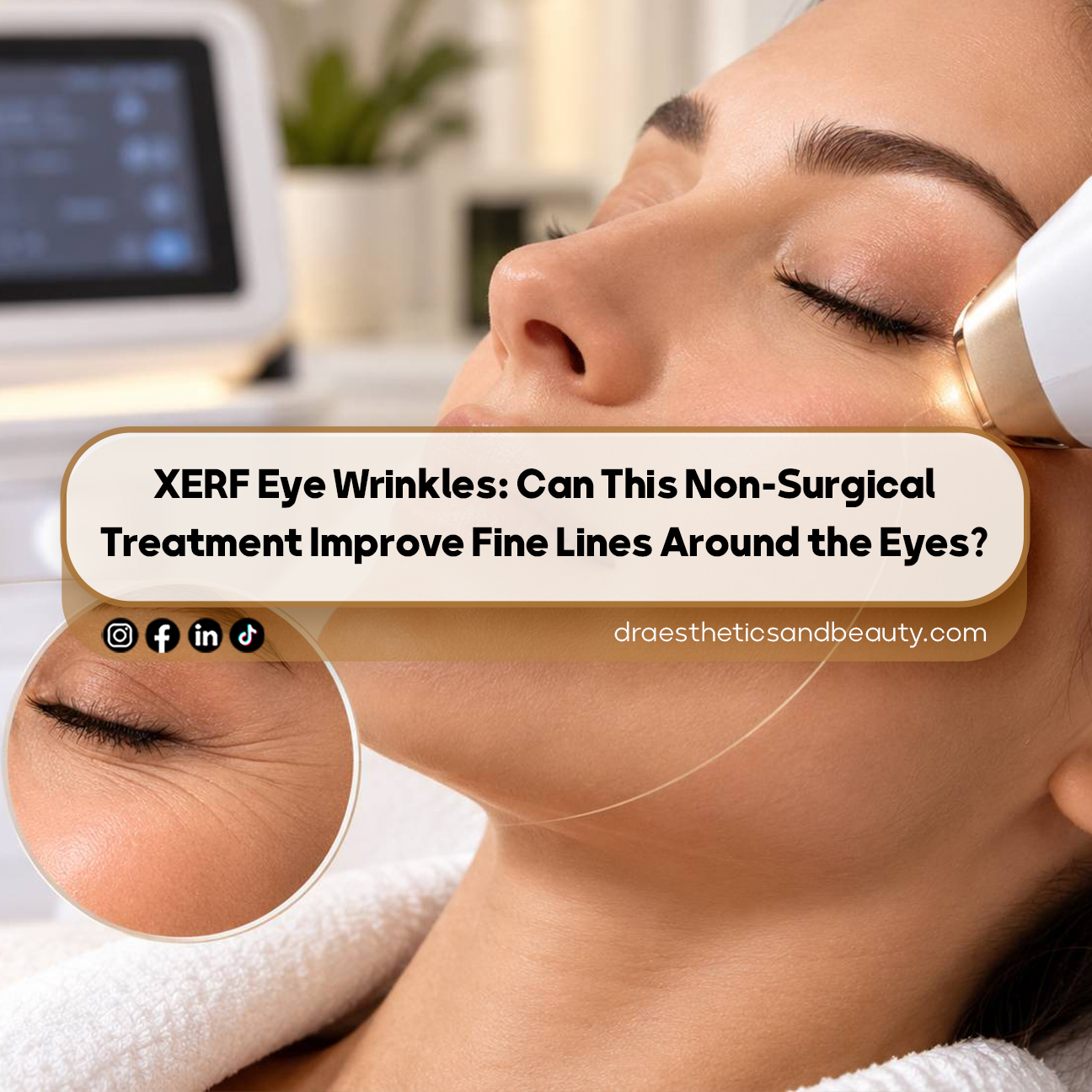
XERF uses non-invasive monopolar radiofrequency technology designed to deliver controlled energy into facial tissues. The goal is to support skin tightening and gradual improvements in skin quality without surgical incisions. However, the extent of improvement around the eyes depends on the type of wrinkles, baseline skin condition, treatment technique, and individual response.
Quick Summary: What to Know About XERF Eye Wrinkles
- What it is: XERF is a non-surgical treatment using dual-frequency monopolar radiofrequency technology.
- What it may address: Selected fine lines, mild skin laxity, and certain changes in skin texture around the eyes.
- How it works: Controlled thermal energy interacts with skin tissue and may support collagen remodeling over time.
- When results appear: Some changes may be noticed early, while potential improvements in skin quality can develop over several weeks to months.
- Who may benefit: Appropriately assessed adults with mild to moderate laxity or fine lines who want a non-surgical option.
- Important limitation: XERF cannot guarantee wrinkle removal, and evidence specifically evaluating eye-area outcomes remains limited.
- Next step: A professional consultation can help determine whether XERF is suitable or whether another treatment better matches your concerns.
Three Things to Understand Before Choosing XERF
- Identify the type of eye wrinkles. Fine surface lines, expression-related crow’s feet, and loose skin around the eyelids do not necessarily respond to the same treatment.
- Understand the technology and its limitations. Radiofrequency may support skin remodeling, but it cannot reproduce every effect of surgery, injectables, or resurfacing treatments.
- Choose treatment based on an individual assessment. Skin characteristics, eye anatomy, medical history, and realistic expectations all matter when planning periorbital rejuvenation.
What Is XERF Treatment?
XERF is a non-invasive monopolar radiofrequency platform developed for structural skin tightening. It uses dual-frequency energy, commonly described as 6.78 MHz and 2 MHz, to create controlled heating in targeted tissue layers. This approach is intended to address aspects of skin laxity and facial aging without the incisions associated with surgery.
Radiofrequency energy has been used in aesthetic medicine because controlled heating can affect collagen-containing tissues. Collagen is a structural protein that contributes to the skin’s firmness and support. As collagen changes with age and environmental exposure, skin may gradually become less elastic, and fine lines can become more noticeable.
When a radiofrequency treatment is appropriately selected and performed, thermal stimulation may contribute to collagen contraction and subsequent remodeling. These processes are not instantaneous, and their visible effects vary between individuals.
XERF should not be described as a guaranteed cure for eye wrinkles. It is better understood as one possible option for selected patients seeking improvement in skin firmness and texture. The suitability of treating the periorbital region depends on the device’s applicable instructions, the available treatment applicators, and the qualifications of the treating professional.
How Is XERF Different from Conventional Radiofrequency?
Conventional radiofrequency treatments differ in their electrode design, energy delivery, depth of tissue interaction, temperature control, and treatment protocols. XERF is designed to deliver dual-frequency monopolar radiofrequency energy within a treatment pulse.
However, a technical difference does not automatically establish superior clinical results. Device-specific research, appropriate treatment selection, and reliable outcome measurements are necessary before concluding that one platform is more effective than another for a particular concern.
For patients considering XERF eye wrinkles treatment, the most relevant questions are whether the device is suitable for the specific area, what level of improvement is realistic, and how the treatment compares with alternatives for the individual’s type of wrinkles.
What Causes Eye Wrinkles?
Understanding why wrinkles develop around the eyes helps explain why no single treatment works equally well for everyone. Several processes may contribute simultaneously, including natural aging, repeated facial expressions, ultraviolet exposure, dryness, and changes in the skin’s supporting structures.
1. Natural Collagen and Elastin Changes
Collagen helps provide structural support, while elastin contributes to the skin’s ability to stretch and return toward its original shape. With age, these supportive components change, and the skin may become thinner or less resilient.
As a result, lines that initially appear only during facial movement may gradually remain visible at rest. Treatments designed to support skin firmness may be considered when reduced elasticity is a major concern.
2. Repeated Facial Expressions
Smiling, squinting, and narrowing the eyes repeatedly activate the muscles around the outer corners of the eyes. Over time, these movements can contribute to crow’s feet.
Because expression-related wrinkles have a muscular component, a skin-tightening treatment may not address their underlying cause as directly as a treatment designed to reduce muscle activity. A professional assessment can help distinguish dynamic lines from wrinkles that remain visible when the face is relaxed.
3. Ultraviolet Exposure
Repeated exposure to ultraviolet radiation contributes to photoaging. The effects can include rough texture, uneven pigmentation, reduced elasticity, and more pronounced wrinkles.
Daily broad-spectrum sun protection, sunglasses, and protective habits are important parts of long-term skin care. An in-office procedure should not replace these measures.
4. Dehydration and Skin Barrier Changes
When the skin barrier is compromised or the surface is dehydrated, fine lines may become temporarily more noticeable. This does not always indicate a substantial loss of collagen or structural skin laxity.
A suitable moisturizer and a gentle skin-care routine may improve the appearance of superficial dehydration lines. These measures are different from treatments intended to remodel deeper skin structures.
5. Under-Eye Volume Changes and Skin Laxity
The appearance of aging around the eyes is not caused by wrinkles alone. Changes in facial volume, under-eye hollows, puffiness, and excess skin can create shadows or folds that resemble more pronounced wrinkles.
Radiofrequency-based tightening may be considered for selected laxity concerns, but it does not replace lost volume in the way a suitable volume-restoring procedure may. It also cannot reliably correct prominent under-eye bags or substantial excess eyelid skin.
How May XERF Help Improve Eye Wrinkles?
The potential value of XERF lies in its use of controlled radiofrequency energy to interact with collagen-containing tissues. The intended outcome is a gradual improvement in selected aspects of skin firmness and quality rather than an immediate, complete elimination of every line.
Supporting Collagen Remodeling
Collagen remodeling refers to changes in the organization and structure of collagen over time. Following controlled thermal stimulation, tissue responses may contribute to a firmer appearance. The visible result depends on the individual’s baseline skin condition and biological response.
It is important to distinguish a plausible biological mechanism from a guaranteed clinical outcome. The fact that radiofrequency can influence collagen-containing tissues does not mean every patient will experience the same degree of wrinkle reduction.
Improving the Appearance of Mild Skin Laxity
Some people notice fine creasing alongside mild looseness around the eyes. When laxity is an important part of the concern, a tightening-oriented treatment may be considered after assessment.
The upper eyelid, lower eyelid, temple, and outer eye corner have different anatomical characteristics. Treatment planning should account for these differences rather than applying a uniform approach to the entire eye area.
Supporting Overall Skin Quality
Skin quality includes texture, evenness, and the visibility of fine lines. Some early clinical observations involving XERF have reported improvements in measured facial skin-quality parameters, including wrinkle scores. However, the available research is still developing, and small or retrospective studies cannot establish how reliably these results will apply to every patient.
Anyone considering treatment should ask the provider what published evidence is available for the exact device, treatment area, and intended outcome. Results from a different radiofrequency device should not automatically be treated as proof of equivalent XERF outcomes.
What XERF May Not Correct
XERF is not a universal solution for all concerns around the eyes. It may be less appropriate as a stand-alone option when the primary issue is:
- Deep expression lines caused mainly by repeated muscle movement.
- Pronounced under-eye hollows caused by volume loss.
- Significant fat pads or persistent under-eye bags.
- Marked excess upper-eyelid skin requiring surgical evaluation.
- Dark circles caused primarily by pigmentation, visible blood vessels, or anatomical shadowing.
- Fine lines that are mainly related to temporary surface dehydration.
A careful diagnosis helps prevent mismatched treatment choices and supports more realistic expectations.
Which Eye Areas Can Be Assessed for XERF?
The phrase “eye wrinkles” describes several different concerns. A consultation should identify the exact location and type of the lines before determining whether a radiofrequency approach is appropriate.
Crow’s Feet
Crow’s feet are the fine lines that appear near the outer corners of the eyes. They often become more prominent when smiling or squinting. Skin quality and laxity can influence how visible they remain when the face is relaxed.
For patients whose primary concern is crow’s feet, a provider should determine whether the lines are mainly dynamic, static, or a combination of both. XERF may be discussed when skin laxity is part of the concern, but it should not be presented as a direct substitute for every expression-line treatment.
Fine Lines Beneath the Eyes
Fine lines beneath the eyes may reflect thin skin, dryness, cumulative sun exposure, or age-related structural changes. Their causes can overlap, so an assessment should include the skin surface, degree of laxity, and presence of hollowing or puffiness.
The lower eyelid is delicate and close to the eye itself. Treatment should only be considered when the device’s instructions and the practitioner’s training support its use in the intended area. Patients should not assume that a treatment suitable for the cheek is automatically suitable for the lower eyelid.
Upper-Eyelid Skin Laxity
Loose upper-eyelid skin can create a heavier appearance around the eyes. Mild laxity may prompt discussion of non-surgical options, while more substantial excess skin may require an assessment by an appropriately qualified medical professional for other interventions.
It is especially important not to promise that a non-surgical treatment can replace eyelid surgery. The right approach depends on the amount of excess skin, eyelid function, brow position, and the patient’s goals.
The Temple and Outer Brow Region
The position of the brow can influence the appearance of the upper eye area. Some XERF treatment approaches are designed to address selected upper-face or periorbital laxity concerns. Whether treatment is appropriate around the brow or temple must be determined according to the device protocol and individual anatomy.
Who May Be a Suitable Candidate for XERF Eye Wrinkles Treatment?
A suitable candidate is not identified by age alone. Skin condition, the type of wrinkles, medical history, treatment goals, and the safety requirements of the device all influence the decision.
XERF may be worth discussing with a qualified provider if you:
- Have mild skin laxity or fine lines around the eyes.
- Prefer to explore a non-surgical option before considering more invasive procedures.
- Understand that improvement may be gradual and incomplete.
- Can follow the recommended pre-treatment and aftercare instructions.
- Are willing to attend follow-up appointments and assess results over time.
When an Alternative May Be More Appropriate
Another treatment may be more suitable when the concern is primarily muscular, pigment-related, volume-related, or caused by significant excess skin. A practitioner may recommend skin care, a different energy-based procedure, an injectable treatment, or a surgical consultation depending on the diagnosis.
Patients with active skin infections, significant irritation, certain implanted electronic devices, or other relevant medical conditions need an individualized safety assessment. Pregnancy, breastfeeding, recent procedures, medications, and a history of abnormal scarring should also be discussed when relevant.
Do not assume that a treatment is suitable simply because it is non-invasive. Always disclose your medical history and ask the treating professional to explain any contraindications specified in the device instructions.
XERF vs. Other Treatments for Eye Wrinkles
Several approaches can improve the appearance of the eye area, but they work differently. The most useful comparison focuses on the cause of the wrinkles rather than treating all options as interchangeable.
| Treatment | Main Purpose | Potential Role Around the Eyes | Important Limitation |
|---|---|---|---|
| XERF | Radiofrequency-based skin tightening | May be considered for selected fine lines and mild laxity | Device-specific evidence and individual outcomes remain important considerations |
| Neuromodulators | Reduce activity in selected facial muscles | May help selected expression-related crow’s feet | Do not primarily correct loose skin, pigmentation, or volume loss |
| Laser or resurfacing treatments | Improve selected surface texture and photoaging concerns | May be considered for appropriate fine lines and surface changes | Risks, downtime, and suitability vary by device and skin type |
| Dermal fillers | Restore selected areas of lost volume | May be considered for carefully selected hollowing concerns | The under-eye region has specific risks and requires experienced assessment |
| Medical-grade skin care | Support the skin barrier and address selected surface concerns | May improve dryness and help prevent further photoaging | Cannot reproduce the effects of a procedure for substantial laxity |
| Blepharoplasty | Surgically address selected excess eyelid skin or tissue | May be appropriate for significant eyelid skin redundancy or bags | Requires surgical evaluation, recovery, and discussion of operative risks |
This comparison is a general guide, not a personalized treatment recommendation. Some patients may benefit from one approach, while others may require a carefully planned combination. Combining procedures should only be considered after evaluating safety, timing, and the likelihood of additional benefit.
What Happens During a XERF Consultation and Treatment?
A responsible treatment plan starts with an assessment, not with a predetermined number of pulses or a promise of a particular result. The exact procedure can vary according to the device configuration, treatment area, provider training, and the patient’s needs.
Step 1: Skin and Medical Assessment
The provider reviews the patient’s concerns, medical history, previous aesthetic procedures, skin sensitivity, and current skin condition. The assessment should distinguish wrinkles from hollowing, puffiness, pigmentation, and eyelid skin redundancy.
Step 2: Discussing Expectations and Alternatives
The practitioner explains what the treatment is intended to address, what it may not correct, and what alternatives are available. Questions about the evidence for XERF in the specific treatment area should be welcomed.
Step 3: Preparing the Treatment Area
Preparation follows the provider’s protocol and the device instructions. Patients should disclose recent cosmetic treatments, active irritation, relevant medications, implanted devices, and any history of unusual reactions to energy-based procedures.
Step 4: Controlled Energy Delivery
During treatment, the trained provider applies the appropriate handpiece and settings according to the planned area and the manufacturer’s instructions. Energy delivery near the eyes requires particular attention to anatomy, contact, temperature management, and the applicable safety precautions.
Patients should not attempt to reproduce a professional protocol with an unapproved device or use equipment near the eyes without appropriate training.
Step 5: Aftercare and Follow-Up
The provider explains what temporary reactions may occur, how to care for the skin, and when to contact the clinic. Follow-up photographs and assessments can help distinguish meaningful changes from lighting differences, facial expression, and normal variation in appearance.
Does XERF Eye Wrinkles Treatment Hurt?
Comfort can vary with the individual, the treatment settings, the area being treated, and personal sensitivity. Patients may experience warmth, pressure, or brief discomfort during radiofrequency delivery. It would be inaccurate to promise that every treatment is painless.
Ask the provider what sensations are expected and how discomfort is managed. Tell the practitioner immediately if you experience unexpected or severe pain, burning, or another unusual sensation during treatment.
Any decision about numbing products or other comfort measures should follow the device protocol and the provider’s clinical judgment. Do not apply products around the eyes without clear instructions, because the eye area is particularly sensitive.
When Can You Expect to See XERF Results?
Results from energy-based skin treatments can evolve over time. Some patients may notice an early change in skin firmness, while potential collagen-related improvements may take weeks or months to become more apparent. The timing and degree of change cannot be guaranteed.
| Time Frame | What May Occur | What to Remember |
|---|---|---|
| Immediately after treatment | Temporary redness, warmth, or mild swelling may occur; appearance can vary | An immediate visual change does not establish the final result |
| Following days | Temporary treatment-related reactions may settle | Follow the aftercare plan and report concerning symptoms |
| Several weeks | Early changes in skin appearance may become easier to assess | Use consistent photographs and avoid judging results from one image alone |
| One to three months | Potential changes in skin quality and firmness may become more apparent | Individual outcomes vary, and research does not establish a guaranteed timeline for everyone |
Published early clinical observations of XERF have reported progressive changes in certain facial skin-quality and periorbital measurements over follow-up. Such findings are encouraging but should be interpreted cautiously when studies involve small groups, retrospective data, or no comparison group.
Before treatment, ask when your provider recommends evaluating the outcome and whether additional sessions are appropriate. More treatment is not automatically better, particularly around delicate anatomy.
How Long Do XERF Results Last?
The duration of any improvement depends on the individual, the original degree of laxity, the treatment protocol, the skin’s aging process, and lifestyle factors. No non-surgical treatment stops aging permanently.
Because long-term, device-specific evidence is still developing, it is best not to promise that XERF results will last a fixed number of years. Your provider should explain what is known, what remains uncertain, and how follow-up will be handled.
Sun protection, avoiding smoking, gentle skin care, and appropriate management of skin conditions can help support overall skin health. These habits do not guarantee that results will last longer, but they can reduce avoidable contributors to visible skin aging.
XERF Eye Treatment: Risks, Side Effects, and Safety
Non-invasive does not mean risk-free. Radiofrequency treatments deliberately deliver energy to tissue, so correct device use, suitable patient selection, and attention to the anatomy around the eyes are essential.
Possible temporary reactions may include:
- Redness or a sensation of warmth.
- Mild swelling or tenderness.
- Temporary sensitivity in the treated area.
- Discomfort during energy delivery.
Less common but more concerning complications associated with energy-based treatments can include burns, blistering, persistent changes in skin sensation, pigmentary changes, scarring, or unwanted changes in underlying tissue. The actual risks depend on the device, technique, treatment parameters, patient characteristics, and location.
Because the periorbital area is close to the eyes, the provider must follow the manufacturer’s specific safety instructions for that region. Do not assume that a device can be used directly on the eyelids or anywhere within the orbital area merely because it is marketed for facial tightening.
When Should You Contact a Medical Professional?
Contact your treating provider promptly if you develop worsening pain, blistering, unusual swelling, or a skin reaction that does not improve as expected. Eye pain, visual changes, or any sudden disturbance in vision requires urgent medical evaluation.
Before proceeding, ask about the practitioner’s training, the device and applicator being used, the intended treatment boundaries, and the plan for managing adverse reactions. These questions are reasonable parts of informed consent.
How to Prepare for XERF Eye Wrinkles Treatment
Preparation should be individualized and confirmed with the treating professional. The following steps can help make the consultation more productive.
- Share your medical history. Include relevant conditions, medications, allergies, implanted electronic devices, and previous reactions to cosmetic procedures.
- Describe previous treatments. Tell the provider about recent injections, lasers, peels, radiofrequency procedures, or surgery.
- Explain your main concern. Clarify whether you are most concerned about crow’s feet, lower-eye fine lines, upper-eyelid laxity, dark circles, or hollowing.
- Ask about skin-care products. Follow professional instructions about exfoliants, retinoids, and potentially irritating products before and after treatment.
- Plan around important events. Allow time for possible temporary redness or swelling instead of assuming that your skin will look identical immediately after the appointment.
- Discuss realistic outcomes. Ask what degree of improvement is plausible for your specific concern and what alternatives might be more effective.
Do not discontinue prescribed medication or introduce a new treatment before your appointment unless your healthcare professional advises you to do so.
Aftercare Following XERF Treatment Around the Eyes
Aftercare instructions depend on the treatment protocol and the individual’s response. The provider should give clear directions before you leave the clinic.
Keep Skin Care Gentle
Use gentle cleansing and a suitable moisturizer if recommended. Avoid rubbing or aggressively massaging the treated area. Ask when it is appropriate to resume active ingredients such as retinoids, exfoliating acids, or other products that may irritate the skin.
Protect the Skin from Sun Exposure
Use appropriate broad-spectrum sun protection and sunglasses. Follow the provider’s advice about when and how to apply sunscreen around the eyes, avoiding direct contact with the eyes themselves.
Follow Individual Restrictions
Your provider may recommend temporarily avoiding certain activities or products depending on your response and the treatment protocol. Follow those instructions rather than relying on a generic recovery schedule from another procedure.
Monitor Your Recovery
Mild temporary reactions may occur, but worsening or unusual symptoms should not be ignored. Contact the clinic if you are uncertain whether a reaction is expected. Seek urgent assessment for eye pain or visual changes.
How Much Does XERF for Eye Wrinkles Cost?
The cost of XERF varies by clinic, geographic location, treatment area, provider expertise, and the protocol recommended for the patient. Some treatment plans may focus on a limited periorbital area, while others may involve broader facial treatment.
There is no reliable universal price that applies to every patient. A clinic should provide a clear quote after assessing the intended area and explaining what the fee includes.
Factors That Can Influence Pricing
- Treatment area: The scope of treatment can affect appointment time and overall cost.
- Provider experience: Training and experience with the device and delicate facial anatomy may influence fees.
- Number of sessions: The recommended plan depends on the individual assessment; multiple sessions should not be assumed necessary for everyone.
- Consultation and follow-up: Ask whether assessment appointments, follow-up reviews, and any additional services are included.
- Combination treatments: If another procedure is recommended, clarify whether its cost is separate.
When comparing quotes, do not focus on price alone. Confirm that the treatment is appropriate for the concern, the provider is qualified, and the proposed plan follows the device’s safety instructions.
Common Mistakes to Avoid When Considering XERF
Assuming All Eye Wrinkles Have the Same Cause
Crow’s feet, dry surface lines, under-eye hollows, and loose eyelid skin may look similar in photographs but require different approaches. Choosing a treatment without identifying the cause can lead to disappointment.
Expecting Complete Wrinkle Removal
Skin tightening treatments generally aim for improvement rather than perfect, permanent smoothness. Natural facial movement and normal aging continue after treatment.
Relying Only on Before-and-After Photographs
Photographs can be helpful, but lighting, camera angle, expression, makeup, and image processing can change how wrinkles appear. Ask whether photographs are standardized and whether the results represent patients with concerns similar to yours.
Ignoring the Evidence Limitations
Evidence for radiofrequency as a general treatment category should not be confused with strong proof for every device or anatomical area. Ask about the quality, size, and follow-up duration of research specifically involving XERF.
Choosing a Provider Based Only on Discounts
Price promotions do not establish competence or suitability. For treatments near the eyes, practitioner training, appropriate equipment, informed consent, and a clear safety protocol should take priority.
What Does the Clinical Evidence Say About XERF Eye Wrinkles?
Clinical evidence should be considered an essential part of any informed treatment decision. XERF is a newer radiofrequency platform, and the research base is still developing.
Early published clinical observations have examined facial laxity, skin-quality measures, and periorbital changes. Some reports describe improvements over follow-up, but findings from small observational or retrospective studies cannot establish that every patient will benefit or that XERF is superior to other treatments.
Research quality matters. A study without a control group may show that changes occurred after treatment, but it cannot fully determine how much of the change was caused by the device rather than other factors. Small samples and short follow-up also limit conclusions about uncommon adverse events and long-term durability.
When reviewing a treatment claim, consider these questions:
- Was the study performed on XERF itself or on a different radiofrequency device?
- Did the research specifically evaluate the periorbital area?
- Were outcomes assessed objectively, by patient report, or by both methods?
- Was there a control group or a comparison with another treatment?
- How many participants were included, and how long were they followed?
- Were adverse events recorded and reported clearly?
A trustworthy provider should be willing to discuss uncertainty. Honest explanations of benefits, limitations, and alternatives are more useful than absolute claims that a treatment is risk-free, permanent, or guaranteed to remove wrinkles.
How to Choose a Clinic for XERF Eye Rejuvenation
Choosing the right clinic involves more than finding a device in your area. The quality of the assessment and the provider’s understanding of periorbital anatomy can affect both treatment selection and safety.
Before booking, consider asking the following questions:
- Who will assess me and perform the treatment?
- What training and experience does the practitioner have with XERF?
- Is the proposed applicator intended for my specific treatment area under the device instructions?
- What results are realistic for my type of wrinkles?
- What are the most relevant risks and contraindications in my case?
- What alternatives should I consider, and why?
- What follow-up is provided if I experience an unexpected reaction?
- How will the clinic evaluate results objectively?
Look for a clinic that explains the reasoning behind its recommendations, gives you time to ask questions, and does not pressure you into purchasing treatment before you understand your options.
Frequently Asked Questions About XERF Eye Wrinkles
1. Can XERF remove eye wrinkles completely?
No treatment can guarantee complete wrinkle removal. XERF may be considered for selected fine lines and mild skin laxity, but results depend on the type of wrinkles, skin condition, treatment protocol, and individual response.
2. Is XERF suitable for crow’s feet?
It may be discussed when skin laxity contributes to the appearance of crow’s feet. If the lines are primarily caused by muscle movement, another approach may be more appropriate. A consultation can help distinguish the main cause.
3. Can XERF treat wrinkles beneath the eyes?
Potential suitability depends on the device instructions, applicator, anatomy, and practitioner training. The lower eyelid is delicate, so treatment should only be considered after an appropriate safety assessment.
4. Does XERF help with upper-eyelid wrinkles?
XERF may be discussed for selected upper-face or periorbital laxity concerns where the device protocol permits it. Significant excess eyelid skin may require a different assessment, including possible surgical consultation.
5. How soon will I see results from XERF?
Timing varies. Some early changes may be noticed sooner, while potential improvements in skin quality can evolve over several weeks or months. Your provider should explain the expected assessment timeline without guaranteeing a specific outcome.
6. How many XERF sessions are needed for eye wrinkles?
There is no single session count appropriate for everyone. The recommended plan depends on the treatment area, skin condition, device protocol, and response. Ask for an individualized plan rather than assuming that a package is necessary.
7. Is XERF painful?
Sensation varies. Patients may experience warmth, pressure, or temporary discomfort. Ask the provider what to expect and how comfort is managed during the procedure.
8. Is there downtime after XERF?
Recovery varies by patient and protocol. Temporary redness, warmth, swelling, or tenderness may occur. Do not assume that there will be no downtime; plan according to the advice of your treating professional.
9. Is XERF safe around the eyes?
Safety depends on correct patient selection, the specific device instructions, suitable applicators, treatment settings, and practitioner training. Treatment near the eyes requires particular care. Discuss risks and precautions before proceeding.
10. Can XERF eliminate dark circles?
Dark circles have different causes, including pigmentation, visible vessels, volume loss, and shadowing. A tightening treatment will not necessarily address these causes. The underlying reason should be identified before selecting a treatment.
11. Is XERF better than laser treatment for eye wrinkles?
Neither option is universally better. Radiofrequency and laser treatments interact with tissue differently, and their suitability depends on the concern, skin type, treatment settings, risks, and expected recovery. A personalized comparison is more useful than a general ranking.
12. Can XERF replace eyelid surgery?
No. XERF should not be presented as a replacement for surgery when substantial excess eyelid skin or other structural concerns require surgical evaluation. Non-surgical treatments and surgery have different purposes and limitations.
13. Are XERF results permanent?
No non-surgical skin treatment stops natural aging permanently. The duration of any improvement varies, and long-term outcomes depend on individual factors. Ask the provider what is known about durability and whether maintenance has been studied for your treatment plan.
14. How much does XERF eye treatment cost?
Pricing varies according to clinic, treatment area, practitioner, and recommended protocol. Request a written quote that explains what is included and whether consultations or follow-up visits are charged separately.
15. What should I do before booking XERF?
Arrange an assessment with a qualified provider, explain your main concerns, disclose relevant medical history and previous procedures, and ask about expected outcomes, alternatives, risks, and aftercare.
Conclusion: Is XERF Worth Considering for Eye Wrinkles?
XERF offers a non-surgical radiofrequency approach that may be worth discussing for selected concerns involving fine lines, skin quality, and mild laxity around the eyes. Its dual-frequency technology is designed to deliver controlled energy into tissue, with the aim of supporting skin tightening and remodeling over time.
However, the right treatment depends on what is actually causing the wrinkles. Crow’s feet, lower-eye fine lines, upper-eyelid skin redundancy, dark circles, and under-eye hollowing are not interchangeable concerns. A treatment that may help one issue may have limited value for another.
Because XERF-specific clinical evidence is still developing, patients should approach claims about guaranteed results, permanent wrinkle removal, or superiority over other treatments with caution. A qualified assessment, clear information about risks, and realistic expectations are essential parts of a responsible treatment decision.
If you are exploring options for eye rejuvenation, the most useful first step is to discuss your concerns with a qualified aesthetic professional who can explain whether XERF is appropriate for your anatomy and goals or whether another treatment may be a better fit.
Explore Your Options for Eye Rejuvenation
Concerned about fine lines, crow’s feet, or mild skin laxity around your eyes? A personalized consultation can help you understand the available options, expected outcomes, and safety considerations before choosing a treatment.
Contact DRAEsthetics and Beauty to learn more about the clinic’s aesthetic services and discuss the approach that may best suit your needs.
Make an informed decision based on your skin, your goals, and a professional assessment.